

INTRODUCTION
Throughout history, film has played an integral role in shaping cultural consciousness, as well as reflecting and reinforcing societal attitudes. Although it can be a powerful tool for expression and resistance, it has also been used to uphold systems of oppression particularly through the misrepresentation of marginalized groups such as Black women who have historically been subjected to some of the most harmful cinematic stereotypes.
As Black feminist scholar Deborah King (1988) notes, Black women experience “triple jeopardy” – the simultaneous oppression of race, gender, and class. These intersecting forces have long defined how Black womanhood is portrayed on screen. Western cinema has perpetuated controlling images that serve to justify and maintain inequality (Collins, 1998). In contrast, African cinema has often sought to reclaim these representations, offering more complex and autonomous depictions.
This essay examines two contrasting films, Victor Fleming’s Gone with the Wind (1939) and Ousmane Sembène’s Black Girl (1966), to highlight how post-colonial African film refutes and reclaims harmful stereotypes of Black women.
HISTORICAL CONTEXT
Since the early 20th century, mainstream Hollywood cinema has caricatured Black characters, especially Black women, through roles that center servitude, hyper-sexualization, and hyper-aggression. The Mammy, Jezebel, and Sapphire archetypes functioned as “controlling images” that upheld white supremacy and patriarchy (Collins, 1998). These stereotypes were not just entertainment, they were ideological tools that blamed Black women for their own oppression, rather than support in their struggles.
In stark contrast, the emergence of post-colonial African cinema, especially during the 1960s, sought to dismantle Western-imposed images. In 1975, the Pan African Federation of Filmmakers (FEPACI) explicitly rejected Western film codes, advocating instead for portrayals that reflect African realities. Filmmakers like Sembène responded by creating narratives that reclaimed Black womanhood from colonial and patriarchal perversion. As Zulu Sofola argues, the ”de-womanization of Black womanhood” imposed by colonial ideologies has been actively contested by African creatives who offer portrayals that display agency, dignity, and resistance (Ukadike, 1994).
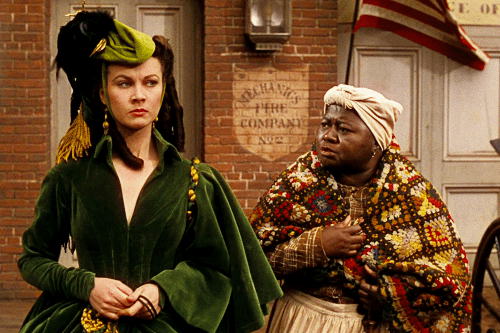
The Mammy in Gone with the Wind
Victor Fleming’s Gone with the Wind remains one of the most celebrated films in American cinema, yet its portrayal of Black characters, especially Mammy, reveals how film can romanticize and reinforce racial hierarchy. Actress Hattie McDaniel’s Mammy is presented as a loyal, maternal figure devoted to the white O’Hara family, particularly Scarlett. She is a character entirely defined by her service to whiteness.
One key scene that illustrates this dynamic is when Mammy laces Scarlett into her corset, pulling it tightly while scolding her for not caring about appearances. She states, “If you don’t care what folks say about this family, I does!”, a line that reveals how deeply Mammy has internalized her role as the guardian of white respectability. Her actions reflect the stereotype of the “devoted slave” whose loyalty to the white family overrides any allegiance to her own identity or community. As Charlene Regester argues, Mammy becomes a tool of white supremacy, enforcing racial and gender norms by disciplining Scarlett into the ideals of Southern womanhood.
Mammy is further dehumanized through visual coding that desexualizes her, a common cinematic tactic used to portray Black women as non-threatening. She is depicted as older, heavy-set, and dressed in shapeless, utilitarian clothing—a stark contrast to Scarlett’s youthful beauty and fashionable, figure-accentuating attire. This contrast erases Mammy’s femininity, reducing her identity to labor and servitude. In one scene, she disapprovingly comments on Scarlett’s revealing dress, positioning herself as a moral enforcer while remaining sexless and invisible. This dynamic not only reinforces the erasure of Black womanhood but also upholds white femininity as the ideal, placing it in a position of cultural and visual superiority.
Despite occasional moments of assertiveness, Mammy is never allowed true agency. Her comedic lines and scolding tone serve to amuse white audiences rather than subvert the racist order, thereby reinforcing the idea that her identity and purpose are tied entirely to white respectability. She exists not as a character, but as a prop, one that comforts and supports white nostalgia for the antebellum South.
COMPARATIVE ANALYSIS
By contrast, Ousmane Sembène’s Black Girl presents a radically different image of a Black woman in servitude—one rooted in autonomy, liberation, and resistance. The film follows Diouana, a young Senegalese woman who moves to France with her white employers under the illusion of a better life, only to find herself trapped in a domestic prison.
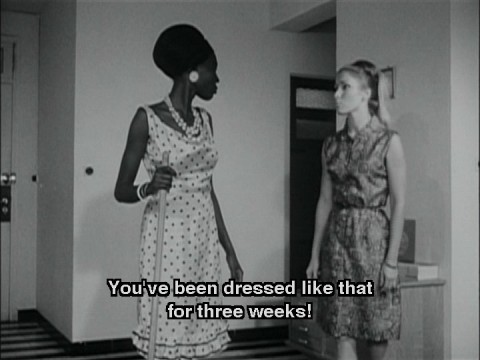
Diouana’s experience exposes the neocolonial dynamics that reduce her to an exotic servant. Yet, unlike Mammy, she resists this role in both subtle and overt ways. Her clothing, for instance, becomes a site of rebellion. She wears stylish dresses (often ill-suited for housework) as a means of reclaiming her identity. When her employer fastens an apron around her waist, it’s more than an instruction, it’s a symbolic attempt to impose control. But Diouana refuses to give up her personal clothing beneath it, maintaining a quiet defiance. As Donna McCormack argues, “The body is the site through which colonial rule and national desires are played out,” and Diouana’s body becomes a battleground of resistance.
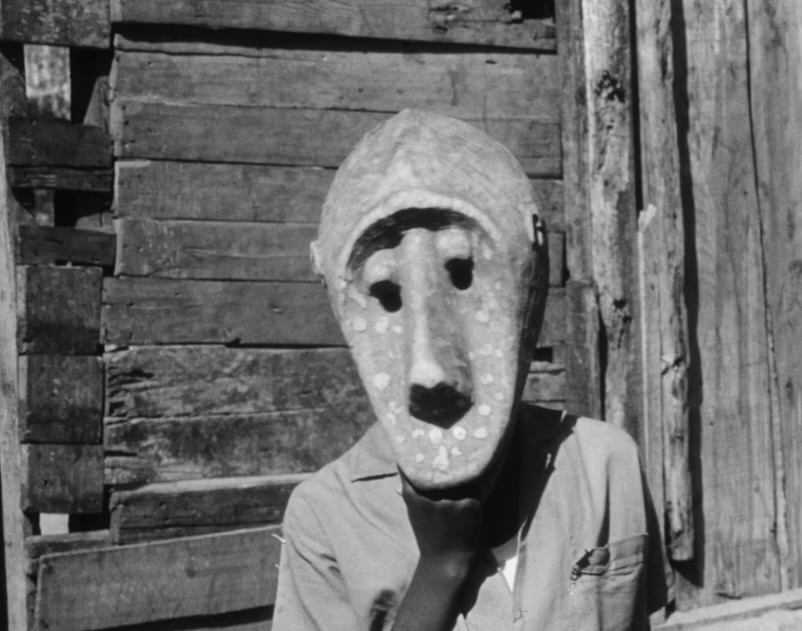
Another powerful moment of resistance is Diouana’s struggle over the African mask she had gifted the family. The mask, displayed on a stark white wall, mirrors her own displacement and objectification. Like the mask, Diouana is seen but not heard—valued for her exoticism rather than her humanity. When she attempts to reclaim it, the act symbolizes her refusal to be a passive decoration in a white space. It’s an assertion of cultural identity and personal autonomy.
Perhaps the most tragic yet powerful act of resistance is Diouana’s suicide. Sembène does not frame this as a defeat, but as a final rejection of the forces that robbed her of her voice, body, and future. Her death is a protest, and in it, she regains control. The haunting image of her blood staining the bathroom (once her workspace) highlights this reversal. In death, Diouana becomes a symbol of liberation, refusing to live a life constrained by white cultural expectations.
CONCLUSION
Mammy and Diouana occupy similar positions as Black women in domestic servitude, but their portrayals could not be more different. Mammy’s character is stripped of complexity and placed within a white-centered narrative that demands loyalty and silence. She has no personal history, no goals, and no future. Her moments of assertiveness are framed for humor, not resistance. Her role reinforces a fantasy of harmonious slavery designed to soothe white guilt.
Diouana, on the other hand, is constructed as a complex, reflective, and increasingly resistant woman. Her refusal to conform to expectations, her symbolic reclaiming of identity, and her tragic death all contribute to a narrative that critiques colonial power andracial objectification.
Where Mammy’s desexualization renders her invisible, Diouana’s hyper-visibility as an “exotic other” highlights a different but equally violent form of stereotyping. In one disturbing scene, a white guest kisses Diouana and says, “I’ve never kissed a Black woman before”, reducing her to a fetishized body. Sembène uses this moment to expose the sexual commodification that exists beneath the surface of colonial “hospitality”.
Diouana’s death, in Sembène’s hands, becomes a critique of post-colonial power dynamics, illustrating how newly “liberated” Africans remained trapped in cycles of servitude under European dominance. The film frames her suicide not merely as despair, but as a final act of resistance, a reclaiming of autonomy through self-destruction. This is symbolized by her rejection of Madame’s clothes, her braided hair (a return to cultural identity), and the haunting image of her blood staining the bathroom she was forced to clean. By transforming a silenced voice into a cinematic landmark, Sembène forces audiences to confront the question: Is it better to die as Diouana or live like Mammy? Is it better for Black women to conform to Western stereotypes or abandon them completely?
References
- Scarlett (Vivien Leigh) & Mammy (Hattie McDaniel in the corset scene From Gone In The Wind, 1939 .Pinterest
- Collins, P.H., 1998. Black feminist thought: Knowledge, Consciousness, and the Politics of Empowerment. New York: Routledge
- King, D.K., 1988. Multiple jeopardy, multiple consciousness: The Context of a Black Feminist ideology. Signs: Journal of Women in Culture and Society
- Ukadike, N.F., 1994. Black African cinema. Berkeley: University of California Press.
 The ANS Archives
Leave a comment